When young people stop feeling heard

Dear Reader,
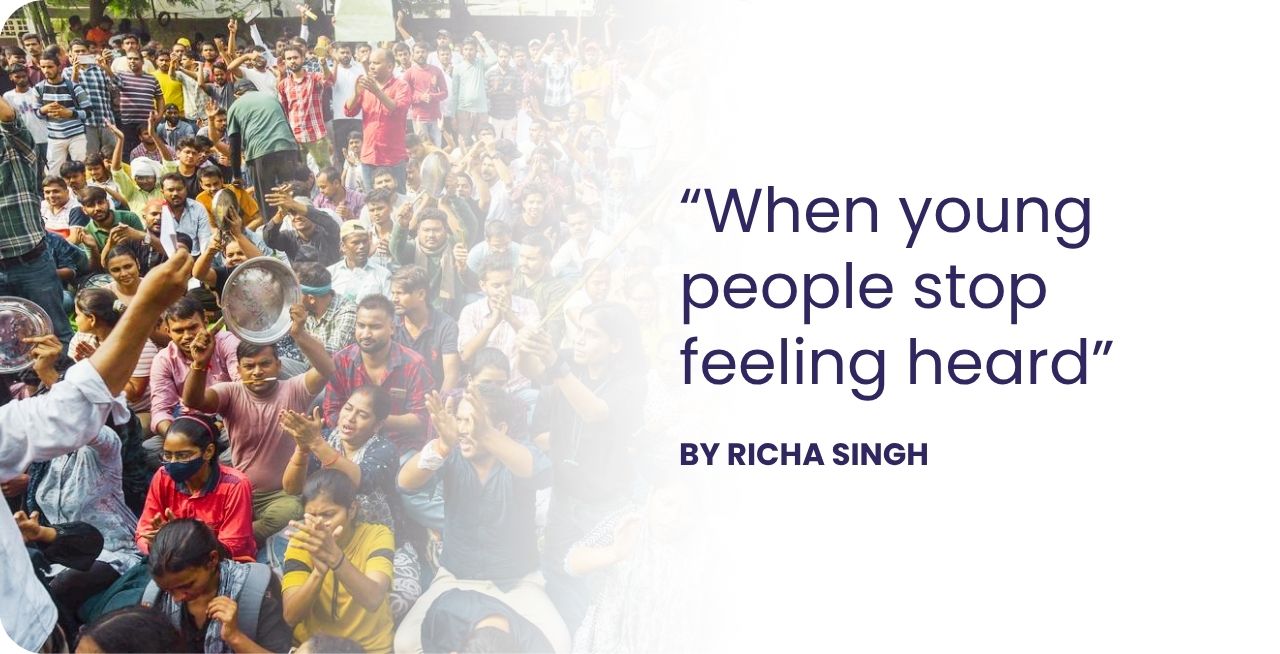
Over the last few weeks, I have found myself thinking about the student protests we have been seeing across the country. On the surface, they are about examinations, paper leaks, re-tests, marks, admissions, accountability, and fairness. All of these are important, and they deserve serious attention. But beneath the headlines and slogans, I believe there is also something deeply emotional that we cannot afford to miss. These protests are also about what happens when young people feel unheard for too long.
For many students, an exam is not just an exam. It carries years of effort, family hopes, financial sacrifice, personal identity, and the fear that one mistake, or one unfair process, could change the course of their future. When students feel that the systems around them are unclear, inconsistent, or unfair, the distress is not limited to disappointment. It can become anger, helplessness, mistrust, and exhaustion. That emotional burden does not disappear simply because a result is declared or a process moves forward.
This is why I feel institutions need to listen to student anger with more care. Anger is often treated as something to manage, contain, or move past quickly. But in many cases, anger is also a signal. It tells us that someone feels unseen, powerless, or afraid. It tells us that the emotional contract between a young person and the institution they trust may have been strained. When students protest, the question cannot only be, “How do we restore order?” It must also be, “What pain did we fail to hear earlier?”
It tells us that the emotional contract between a young person and the institution they trust may have been strained.
This is especially important for campuses, because students do not experience academic uncertainty in isolation. They experience it alongside peer comparison, parental expectations, financial pressure, social media noise, and the constant fear of falling behind. A delay, error, rumour, or unclear communication can quickly become overwhelming when it sits on top of everything else they are already carrying. In such moments, students need more than circulars and instructions. They need transparency, emotional first aid, counselling access, trusted adults, and spaces where they can speak without being dismissed as dramatic, entitled, or disruptive.

But this is not only a campus issue. The same young people will soon enter workplaces, and many already do, carrying their experiences of institutional uncertainty with them. They are entering professional life with sharper questions about fairness, voice, accountability, and trust. They are less likely to accept silence as strength or opacity as authority. For organisations, this is a moment to recognise that the next generation of talent is not only looking for opportunity. They are looking for systems that are humane, leaders who listen, and cultures where speaking up does not feel risky.
At YourDOST, we often see that distress does not always arrive as sadness. Sometimes, it shows up as anger, withdrawal, cynicism, irritability, panic, silence, or a sudden loss of motivation. These are not behaviours to be judged in isolation. They are signals to be understood. Whether we are working with a student, an employee, a parent, a faculty member, or a manager, the work often begins with creating enough safety for the real emotion to surface. Once someone feels heard, they are more likely to reflect, seek support, and find a way forward.
This moment should make all of us ask harder questions about the environments we are building. Do students and young employees know where to go when they feel overwhelmed? Do they trust that their concerns will be taken seriously? Do our institutions communicate clearly in moments of uncertainty? Do our leaders know how to respond when frustration is really fear in another form? These questions matter because emotional well-being is not built only through counselling sessions. It is built through everyday experiences of fairness, clarity, dignity, and care.
My hope is that we do not look at young people’s anger only as a disruption. Sometimes, it is a plea for the systems around them to become more responsive. Sometimes, it is the only language they feel is left when quieter attempts have failed. As parents, educators, employers, and leaders, we may not always have immediate answers to every difficult situation. But we can listen sooner. We can communicate more honestly. We can create spaces where young people do not have to reach a breaking point before they are taken seriously.
If your campus or workplace is thinking about how to support students, early-career employees, managers, or teams through uncertainty, stress, or difficult transitions, I would be happy to have that conversation. Sometimes, care begins very simply, by making sure people know they do not have to carry their questions, fears, or anger alone.
Keep Rising & Shining,
Richa Singh
Co-Founder & CEO, YourDOST